
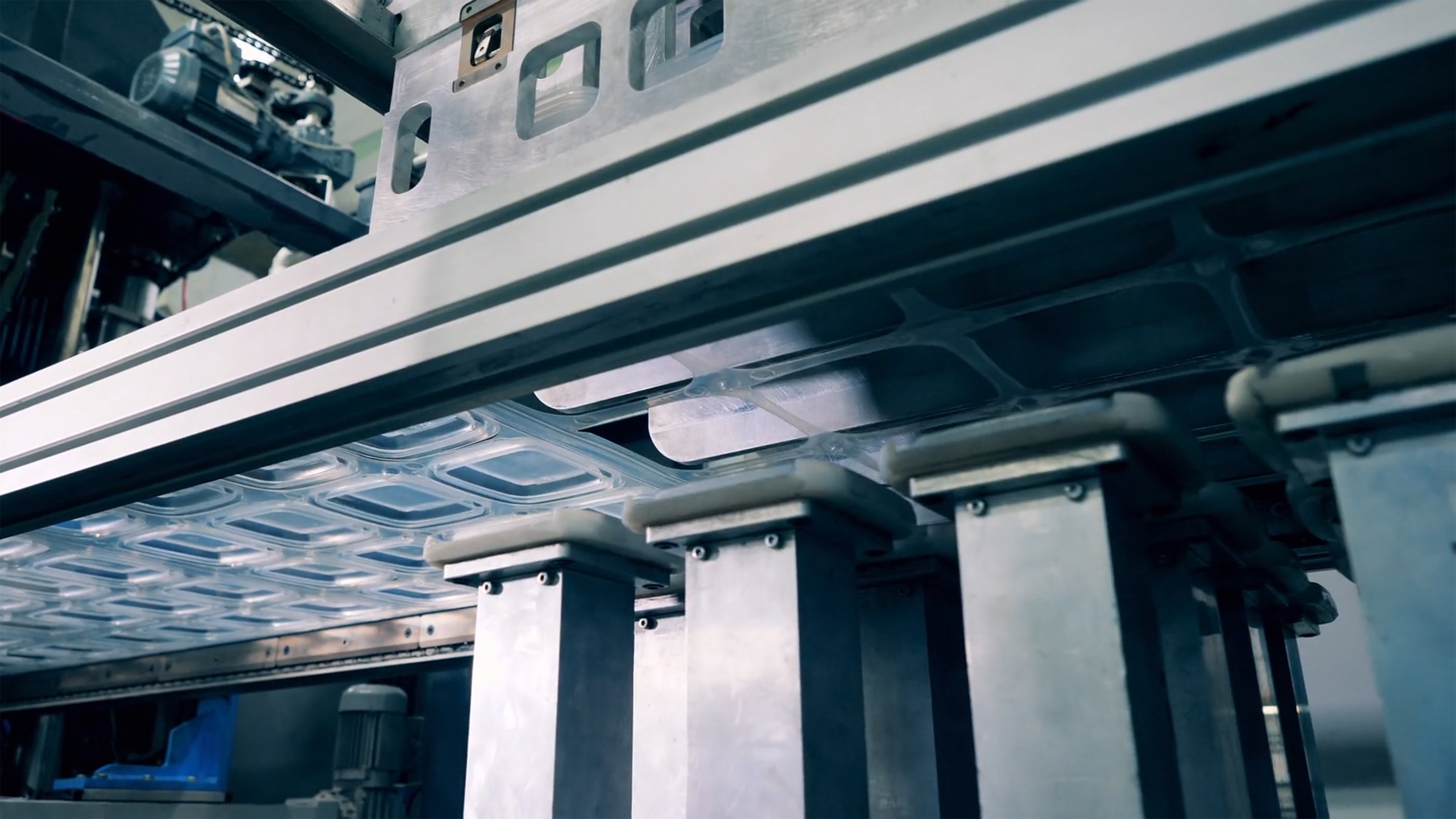
A thermoforming line can run the same tooling, machine settings, and production schedule every day. Yet one production run delivers smooth output while another struggles with uneven forming, rejected parts, and unnecessary material waste.
The difference is often not the machine. It is the film.
For converters, PVC films are expected to perform consistently from the first sheet to the last. When film properties vary across production runs, thermoforming becomes harder to control, conversion efficiency starts falling, and packaging quality becomes less predictable.
That is why film consistency is not simply a material characteristic. It directly influences how efficiently packaging is produced and how reliably it performs in the market.
Why consistency matters before thermoforming even begins
Many thermoforming issues start long before the sheet reaches the forming station.
Variations in thickness, surface quality, or material behavior can affect how the film responds to heat and pressure. The machine may be running correctly, but the material is no longer behaving consistently.
As a result, operators often spend more time adjusting settings, monitoring output, and compensating for material variation instead of focusing on production efficiency.
Over time, that can lead to:
- Increased material waste
- More rejected parts
- Additional machine adjustments
- Lower production efficiency
- Greater process variability
For high-volume converters, even small inconsistencies can increase material waste, reduce line efficiency, and raise conversion costs across every production run.
Why PVC films directly influence forming accuracy
Thermoforming depends on predictable material behavior.
When PVC films heat evenly and respond consistently during forming, cavities form more accurately, dimensions remain stable, and packaging quality becomes easier to control.
When consistency begins to vary, the opposite happens.
The material may stretch unevenly. Certain areas may become thinner than expected. Formed parts may lose dimensional accuracy. In some cases, the packaging may no longer meet the required performance specifications.
This becomes especially important for applications such as:
- Blister packaging
- Consumer goods packaging
- Electronics packaging
- Healthcare packaging
- Retail display packaging
In these applications, dimensional accuracy affects product fit, sealing consistency, and final presentation. Poor fit or inconsistent forming can lead to rejected batches, rework, and additional production costs.
Why thickness consistency affects conversion efficiency
One of the most important factors in thermoforming performance is the consistency of film thickness.
At first glance, minor thickness variations may appear insignificant. But during thermoforming, those variations become much more noticeable.
When thickness remains consistent across the sheet:
- Heat distribution becomes more predictable.
- Forming behavior remains stable.
- Wall thickness distribution improves.
- Tooling performance becomes more reliable.
- Production output becomes more consistent.
The business impact is straightforward. Converters spend less time correcting process variations and more time producing saleable packaging.
That improves throughput while reducing unnecessary waste.
Why stable material behavior reduces production losses
Every converter wants predictable production.
Unexpected material variation often creates a chain reaction across the production line. Forming accuracy starts changing. Reject rates increase. Operators make additional adjustments. Production efficiency gradually declines.
The challenge is that these losses are not always obvious immediately.
They often appear as:
- Higher scrap generation
- Reduced machine uptime
- Increased operator intervention
- Lower production consistency
- More quality-control rejections
When PVC films behave consistently, converters spend less time correcting process variations, reduce scrap generation, and improve production output across every shift.
For manufacturers operating high-volume thermoforming lines, this directly affects profitability.
Why consistency matters beyond the forming station
Thermoforming performance is only one part of the equation.
Once packaging leaves the production line, it must maintain structural integrity, visual quality, and functional performance.
If material consistency varies, the effects can continue downstream.
Packaging may show differences in:
- Appearance
- Rigidity
- Product fit
- Stacking performance
- Consumer presentation
For brand owners, these variations can affect product presentation and customer perception. For converters, they can result in customer complaints, rejected batches, rework, and additional production costs.
This is why leading packaging manufacturers increasingly focus on consistency throughout the material and conversion processes rather than evaluating only the finished pack.
Why process control plays a critical role
Film consistency does not happen by accident. It depends on maintaining control across raw materials, extrusion parameters, thickness distribution, and production monitoring.
When these factors are controlled properly, converters receive material that behaves more predictably during thermoforming.
That predictability supports:
- Better forming accuracy
- Lower rejection rates
- Reduced material waste
- Higher machine utilization
- More saleable packaging output
For converters, these benefits translate into higher throughput, lower scrap rates, and more saleable packaging output from the same production capacity.
Why PVC film consistency matters for business performance
The conversation around packaging materials often focuses on technical specifications. But converters ultimately measure success through operational performance.
A consistent film helps converters keep production running with fewer interruptions and less scrap. Lower waste means more saleable output from the same amount of material. Over time, that improves conversion economics, supports profitability, and helps maintain customer confidence.
That is why PVC film consistency should not be viewed only as a material property.
It is a performance factor that influences productivity throughout the entire thermoforming process.
How AVI Global Plast supports consistent thermoforming performance
At AVI Global Plast, PVC sheets are manufactured through controlled processes to ensure consistent thermoforming performance in demanding packaging applications.
With vertically integrated capabilities in PVC sheet manufacturing and thermoformed packaging, AVI Global Plast focuses on material consistency and process control that help converters reduce variability, minimize rejects, and maintain more efficient production runs.
For customers operating high-volume thermoforming lines, consistency is not simply about material quality. It helps reduce rejects, improve machine utilization, and deliver more saleable packaging with fewer production interruptions.
FAQs
What are PVC films used for in thermoforming?
PVC films are commonly used for blister packaging, consumer goods packaging, healthcare packaging, retail display packaging, and other thermoformed applications that require consistent forming performance and visual clarity.
Why is film consistency important in thermoforming?
Consistent PVC films help maintain predictable forming behavior, improve dimensional accuracy, reduce the number of rejected parts, and support more efficient production.
How does thickness variation affect thermoforming?
Thickness variation can lead to uneven heating, inconsistent material distribution, forming defects, and increased scrap during production.
Can film consistency improve conversion efficiency?
Yes. Consistent material behavior reduces machine adjustments, lowers rejection rates, improves throughput, and supports more stable production output.
Why do converters focus on material consistency?
Material consistency helps ensure predictable thermoforming performance, improving packaging quality, reducing waste, and enhancing overall operational efficiency.
Why consistency creates better conversion outcomes
Most thermoforming challenges are not caused by a single major failure. They develop gradually through material variation, process adjustments, and inconsistent production behavior.
That is why converters increasingly focus on film consistency as a foundation for operational performance.
When PVC films deliver predictable behavior, converters spend less time correcting process variations, generate less scrap, and produce more saleable packaging from the same production run.
That directly improves conversion efficiency and overall production profitability.
At AVI Global Plast, PVC sheet consistency is built into the manufacturing process to help converters achieve stable thermoforming performance, lower rejection rates, and better conversion efficiency across production runs.