
For a long time, packaging decisions were mostly about cost and protection. If the package survived shipping, the job was considered done. That approach has changed quite a bit.
Today, buyers look at recyclability. Retailers look at material usage. Governments focus on waste reduction. Exporters, meanwhile, still care about one thing above everything else: whether the product reaches its destination safely. And balancing all of that is not simple.
A package may look sustainable on paper. But once it starts moving through real export conditions, the situation changes quickly. Pallets stay stacked for long hours. Containers shift during transit. Moisture builds up inside refrigerated environments. Packages move through ports, warehouses, distribution centers, and retail handling systems before finally reaching the shelf.
That is usually where packaging starts to prove whether it was designed properly.
If the structure is too weak, the products can be damaged during transit. If the packaging becomes too heavy, freight efficiency suffers. And if the material is difficult to recycle, brands start hearing about it from both buyers and regulators.
So now the conversation has changed. Companies are not only asking whether packaging is recyclable. They are asking whether it can still perform properly during export.
That is where modern sustainable packaging solutions are evolving.
Why strength still matters in export packaging
Most export packaging looks fine at dispatch. The real pressure starts later. A shipment moving from India to a retailer overseas may spend weeks under stacking pressure while also dealing with vibration, humidity fluctuations, repeated handling, and refrigerated storage conditions.
Most export packaging looks fine at dispatch. The real pressure starts later. A shipment moving from India to a retailer overseas may spend weeks under stacking pressure while also dealing with vibration, humidity fluctuations, repeated handling, and refrigerated storage conditions.
That is usually where small packaging weaknesses first appear.
A lightweight package may reduce material usage, which sounds great initially. But if it starts flexing too much during handling or loses rigidity during stacking, product protection becomes inconsistent very quickly.
Corners begin weakening. Pallets become unstable. Product movement inside the packaging increases.
And once that starts happening, losses follow.
That can lead to:
- Damaged products
- Unstable pallet loads
- Higher rejection risk
- Avoidable transit losses
This is why strength still matters so much in modern sustainable packaging.
The focus today is not simply about reducing material. It is about using material intelligently without compromising packaging reliability.
In thermoformed PET packaging, that often comes down to:
- Wall thickness distribution
- Structural geometry
- Material consistency
- Forming precision
- Load-bearing stability
Well-designed packaging does not just use less material. It stays stable through handling, stacking, storage, and transport conditions.
Why recyclability is becoming a real business expectation
A few years ago, recyclability was mostly treated as a sustainability message. Today, it has become part of procurement discussions and retail expectations across industries.
Large buyers increasingly prefer packaging that works within existing recycling systems instead of structures that are difficult to separate or recover after use.
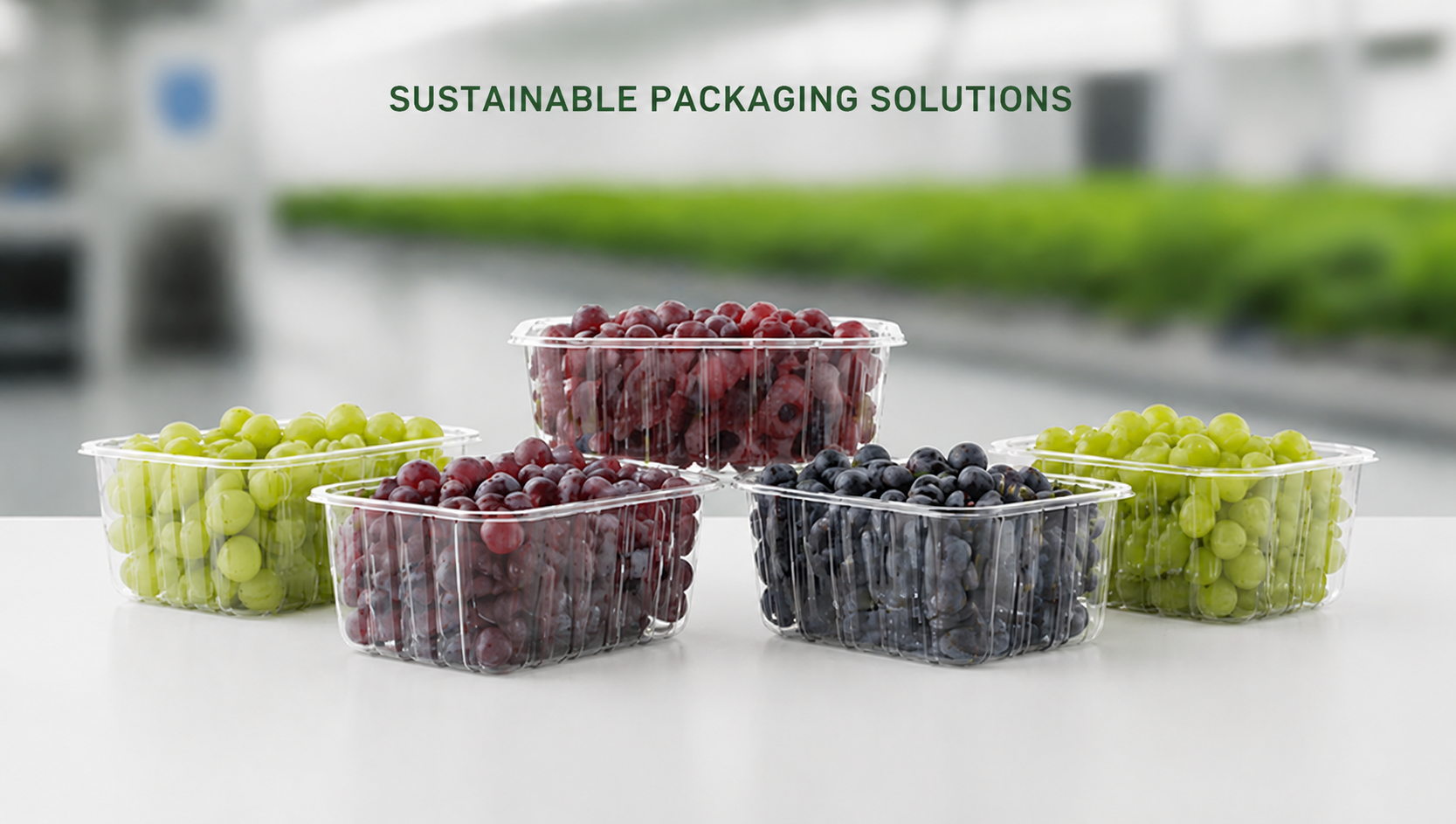
That is one reason mono-material PET packaging is becoming more common across food trays, fresh produce punnets, clamshells, and rigid thermoformed packaging applications.
At the same time, companies are simplifying packaging structures to improve both recyclability and operational efficiency.
That includes:
- Fewer mixed-material combinations
- Simpler packaging structures
- Better material recovery compatibility
- Reduced excess packaging weight
Consumers notice these things too. Excessive packaging stands out quickly, especially in food and retail applications where buyers increasingly expect packaging to feel practical and responsible.
And honestly, this is where packaging conversations have become much more practical. Companies want packaging that performs properly in the real world, not packaging that only sounds sustainable in presentations.
Why lightweight packaging only works when performance stays stable
Reducing packaging weight sounds simple at first. But things change once the packaging enters export conditions. A thinner structure may perform perfectly during filling and sealing. But after long transit cycles, refrigerated storage, and stacking pressure, that same structure may begin losing stability before the shipment even reaches retail shelves.
That is where lightweighting becomes more technical than it first appears.
In thermoformed PET packaging, performance depends heavily on:
- Material behavior
- Forming consistency
- Wall thickness balance
- Stacking strength
- Moisture resistance during transit
Even small inconsistencies can affect how reliably packaging performs across export supply chains.
And in food packaging or fresh produce packaging, those inconsistencies become visible quickly because the packaging still needs to protect the product while remaining recyclable and lightweight.
Why material consistency matters more than people think
Many sustainability conversations focus heavily on the final package. But packaging performance actually starts much earlier at the material level.
In recyclable PET packaging systems, material consistency directly affects:
- Structural performance
- Forming stability
- Clarity
- Stacking reliability
- Packaging repeatability
This becomes even more important when using rPET materials, where feedstock variability can influence processing behavior if extrusion and thermoforming are not carefully controlled.
AVI Global Plast manufactures thermoformed PET packaging solutions using food-contact-compliant rPET materials, ensuring consistency, traceability, and reliable export performance.
Controlled extrusion and thermoforming help maintain packaging stability while also supporting recyclability and operational efficiency across demanding supply-chain conditions.
And that balance matters because businesses today are not willing to compromise on either sustainability or performance. They expect both to work together.
Why sustainable packaging now needs to perform, not just look good
A package may look recyclable on paper. But exporters still ask a much simpler question: will it survive the journey properly?
That is why packaging is no longer judged only by appearance or whether it can technically be recycled.
Exporters, retailers, and manufacturers now expect packaging to perform consistently across transport, refrigeration, handling, storage, and retail display conditions.
Because of that, packaging decisions are increasingly shaped by:
- Recyclability
- Structural strength
- Freight efficiency
- Handling stability
- Shelf-life protection
- Material optimization
And that is exactly where modern sustainable packaging solutions are evolving.
The goal is no longer just reducing material usage. The real challenge is developing packaging that remains recyclable while reliably protecting products in demanding export environments.
Finding the practical middle ground
The future of sustainable packaging will probably not come from extreme solutions. It will come from balance. At the end of the day, the packaging still has to properly protect the product. It still needs to handle stacking pressure, moisture exposure, cold-chain movement, and long transit cycles. At the same time, businesses also need packaging that supports recyclability goals and works efficiently within existing recovery systems.
That is where most packaging decisions are heading today.
At AVI Global Plast, thermoformed PET packaging systems are developed with recyclability, export performance, structural reliability, and operational consistency working together as one connected approach.
The result is straightforward. Packaging that supports sustainability goals while continuing to perform reliably across modern global supply chains.