
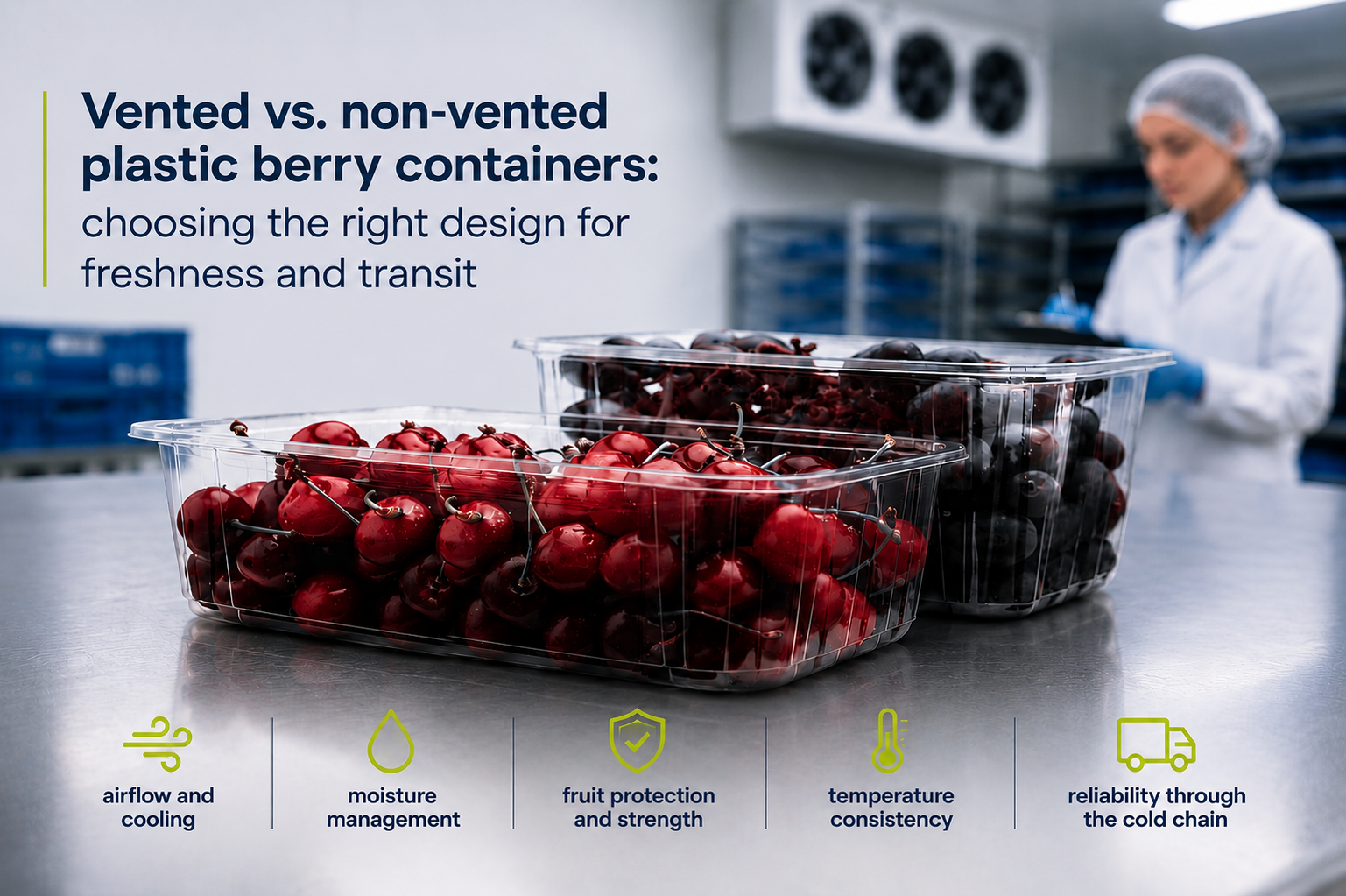
Two berry packs can look almost identical on the shelf, yet behave very differently during cooling and transit. The difference may come down to something as simple as where the package allows air to move.
Choosing between vented and non-vented plastic berry containers is therefore not just a packaging-design decision. It can affect cooling, condensation, fruit protection and the pack’s reliability through the cold chain.
Why venting can change berry quality during cooling
Fresh berries continue to respire after harvest, generating heat and moisture. Vents can support air movement during forced-air cooling and help manage moisture inside the package. This matters during rapid cooling. A vented design can allow cold air to reach the fruit more effectively, reducing the risk of uneven temperature inside the pack.
Vent size, position and total open area all influence airflow. But performance also depends on how the punnets are stacked, whether the vents align with openings in the secondary carton, and how the pack is oriented during cooling. The berry type, closure integrity and wall strength also need to match the intended cold-chain conditions.
When non-vented containers can make sense
Non-vented berry containers can make sense when the packaging system, cooling process and storage conditions are designed around a more enclosed pack. In these cases, controlling when and how the fruit is cooled becomes particularly important.
A 2026 strawberry field trial found that unvented containers extended salable life in the tested conditions, although condensation became a concern when berries were packaged before they had cooled sufficiently.
The practical takeaway is that container choice should match the berry, cooling method, storage temperature and intended transit conditions. The same principle applies to different berry types, as their cooling, moisture and handling requirements may vary.
Why material consistency supports the pack design
The sheet still matters because it determines how reliably the finished punnet can hold its intended shape, vent geometry, wall strength and closure features during thermoforming.
For converters producing high volumes, consistent sheet behaviour helps maintain the dimensions and performance of the finished pack. Material selection should therefore support the container design rather than be considered separately.
Why the whole pack system matters
A berry container has several jobs at once:
- Cooling method and precooling conditions
- Vent size, position and total open area
- Berry type and pack fill
- Stacking and secondary carton ventilation
- Closure integrity and wall strength
- Expected storage and transit conditions
These requirements interact. Increasing ventilation can influence both cooling behaviour and structural design, while a stronger package may require different design considerations around vents and material distribution.
The best plastic berry containers are therefore designed around the complete cooling, handling and distribution process rather than around ventilation alone.
Choosing the right combination of material and design
Vented or non-vented is only one part of the decision. The container design, sheet properties, forming process, cooling method and distribution conditions all need to work together.
AVI Global Plast supports fresh-produce packaging applications with PET-based sheet solutions designed for thermoformed packs where material performance and finished-pack requirements need to work together.
For berry-pack applications, AVI can provide technical guidance on material selection based on the container design, forming requirements and intended application.
FAQs
How much ventilation does a berry punnet need?
No single vent specification fits every berry pack. Consider vent size and total open area alongside the berry type, cooling method, pack design and cold-chain conditions.
Does vent placement affect forced-air cooling?
Yes. Vent position can affect how effectively cold air moves through individual punnets and stacked packs, so consider it alongside secondary-carton ventilation.
Can the same berry pack be used for sea and air freight?
Not necessarily. Transit duration, temperature exposure, handling and cold-chain conditions can differ, so evaluate the pack for the intended distribution route.
Are vented berry containers always better?
No. Vented and non-vented designs can both be suitable depending on the berry, cooling process, packaging configuration and distribution conditions.