
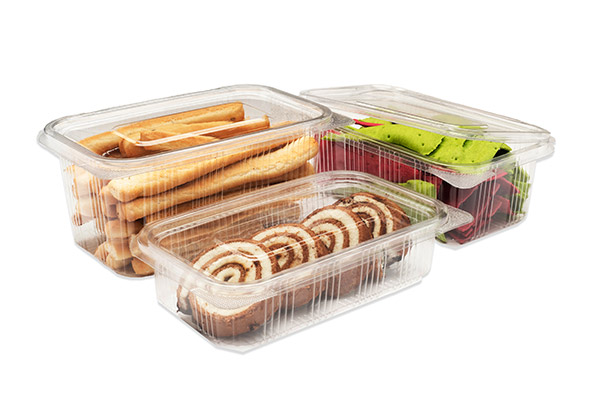
A hinged lid container rarely gets much attention when everything is working as expected.
The lid stays closed. The product remains protected. The package stacks neatly and looks presentable on the shelf. Then it enters the real world.
It gets stacked on pallets, moved through warehouses, transported across distribution networks, handled by retailers, and picked up by customers. That is usually where the difference between an average container and a well-designed one starts becoming visible.
A package may leave the production facility looking perfect and still arrive with damaged corners, unstable stacks, product movement, or reduced shelf appeal. In many cases, the issue is not the product itself. It is the packaging design behind it.
This is particularly true for hinged lid containers, where design details influence much more than just opening and closing the pack.
They affect how products are protected during transport, how efficiently packages stack throughout the supply chain, and how products ultimately appear on the shelf.
What may seem like a simple packaging component often directly impacts handling efficiency, distribution performance, retail presentation, and product protection.
That is why hinged lid container design has become an increasingly important consideration for packaging engineers, retailers, and brand owners alike.
Why product protection starts with container design
When product damage occurs, packaging materials often get most of the attention.
But design is usually part of the story too.
A hinged lid container has a bigger job than simply holding a product.
It needs to keep that product protected as it moves through warehouses, trucks, distribution centers, and retail shelves. If the structure starts losing shape along the way, product protection becomes much harder to maintain.
If the lid fit becomes inconsistent or the structure begins to lose rigidity, the effects become visible quickly.
Products may shift inside the pack. Containers may deform under stacking pressure. Shelf presentation may suffer before the product even reaches the consumer.
That can lead to:
- Product movement inside the container
- Lid-lock failures during handling
- Increased risk of product damage
- Reduced shelf presentation quality
- Higher rejection rates during distribution
The problem is that packaging issues rarely stay confined to the package itself.
Damaged products, customer complaints, replacement costs, and retailer rejections can quickly increase operational expenses while affecting brand perception at the point of sale.
This is why well-designed hinged lid containers are engineered to maintain structural stability throughout handling, storage, transport, and retail display.
Why lid-lock performance affects supply-chain efficiency
A hinged lid may seem like a small part of the package.
But if it does not stay securely closed throughout the journey, the consequences can show up quickly.
A lid that closes securely during filling but opens unexpectedly during transport creates immediate problems. Product protection becomes compromised. Contamination risks increase. Retailers may reject damaged packs before they ever reach consumers.
Reliable lid-lock performance helps maintain:
- Package integrity during transit
- Product protection during handling
- Consistent shelf presentation
- Reduced product loss
- Better customer experience
For manufacturers and retailers, the benefits go beyond packaging performance.
Reliable lid-lock performance helps reduce product loss, minimize handling disruptions, lower returns, and ensure more products reach consumers in saleable condition.
Why stackability affects supply-chain performance
Nobody talks much about stackability when everything is running smoothly.
But when containers start deforming, pallets become unstable, or products arrive damaged, stackability suddenly becomes very important.
Throughout the supply chain, packages are stacked on pallets, stored in warehouses, transported in trucks, and displayed in retail environments. If the container design does not support stable stacking, pressure distribution becomes uneven.
Over time, this can lead to:
- Package deformation
- Product damage
- Unstable pallet loads
- Increased handling risks
- Lower transport efficiency
A well-designed hinged container distributes load more effectively across the structure rather than transferring pressure directly onto the product.
That difference creates measurable business benefits.
Stable stacking helps reduce transit losses, improve pallet utilization, support safer handling, and lower the costs associated with damaged products and rejected shipments.
Why structural rigidity influences retail performance
A package sitting on a retail shelf is still working.
Customers pick it up. Retail staff restocks it. Products are moved, handled, and inspected throughout the day.
If the container starts losing shape during that process, people notice.
Consumers often judge a product by its packaging before they even look closely at what is inside.
A container that looks crushed, bent, or unstable can affect how fresh, premium, or reliable the product appears.
This is especially critical in food packaging, fresh-produce applications, and consumer-goods packaging, where presentation instantly affects buying decisions.
Well-engineered hinged lid containers help maintain:
- Consistent product visibility
- Structural stability during display
- Better shelf presentation
- Reduced handling damage
- Improved consumer confidence
The result is not simply better-looking packaging.
It is a stronger retail performance, improved product perception, and a greater opportunity to convert shelf visibility into sales.
Why thermoforming consistency supports container performance
Good design is important.
But even the best design can only perform as well as the manufacturing process behind it.
Two containers can look identical when they leave the production line. Yet one may stack better, close more consistently, and protect products more effectively once they enter the supply chain.
That difference often comes down to manufacturing consistency.
In thermoformed packaging, variations in wall thickness, material distribution, or forming accuracy can affect how the container performs during stacking, transport, and retail handling.
These differences may appear minor during production. However, they become much more noticeable once thousands of packages move through the supply chain.
Consistent thermoforming helps maintain:
- Structural rigidity
- Lid alignment
- Dimensional accuracy
- Stackability performance
- Package repeatability
The impact becomes visible fairly quickly.
Converters spend less time dealing with quality issues and more time producing saleable packaging.
That helps reduce rejects, reduce material waste, improve production efficiency, and increase the amount of saleable packaging produced per run.
Why packaging design affects business performance
Most packaging decisions are made long before the product reaches a customer. But that is rarely where packaging succeeds or fails.
The real test happens during transport, storage, retail handling, and shelf display.
A container that protects products more effectively reduces damage-related losses. A container that stacks efficiently improves logistics performance. A container that maintains shelf appearance supports stronger retail outcomes.
That is why packaging decisions rarely stay within the packaging department.
They often affect logistics, product quality, customer experience, retail performance, and overall operating costs.
That is why companies increasingly evaluate hinged lid containers not only on appearance but also on how reliably they perform throughout the supply chain.
How AVI Global Plast supports reliable hinged container performance
At AVI Global Plast, the focus is not just on how packaging performs during production but also on how it performs throughout the journey that follows.
Controlled thermoforming helps hinged lid containers maintain reliable closure, stable stacking, and consistent product protection during handling, transport, storage, and retail display.
For customers, the benefits are straightforward. Fewer damaged products, lower rejection rates, reduced packaging-related losses, better handling efficiency, and more products reaching the shelf in the condition they were intended to be sold.
FAQs
What are hinged lid containers used for?
Hinged-lid containers are commonly used for food packaging, fresh produce, consumer goods, retail packaging, and applications requiring secure closure and product visibility.
Why is lid-lock performance important?
Reliable lid-lock performance helps maintain package integrity during handling and transport, reducing product loss and improving supply-chain efficiency.
How does stackability affect packaging performance?
Good stackability helps distribute load evenly, reducing package deformation, product damage, and transport-related losses.
Can hinged lid containers improve retail presentation?
Yes. Well-designed hinged lid containers help maintain structural stability, product visibility, and shelf appearance under retail display conditions.
Why does thermoforming consistency matter?
Consistent thermoforming helps maintain dimensional accuracy, structural rigidity, and repeatable packaging performance across production runs.
Why design consistency drives better packaging outcomes
Packaging performance rarely comes down to a single feature.
The real difference usually comes from how multiple design elements work together once the package enters the supply chain.
The real difference usually comes from how lid fit, structural stability, stackability, and manufacturing consistency work together once the package enters the supply chain.
When hinged lid containers are designed and manufactured consistently, they help protect products, improve handling efficiency, reduce distribution losses, and maintain stronger retail presentation throughout the supply chain.
At AVI Global Plast, packaging is designed for what happens after production, because that is where performance starts becoming visible.
Controlled thermoforming helps hinged lid containers maintain reliable closure, stable stacking, and consistent product protection during handling, transport, storage, and retail display.