
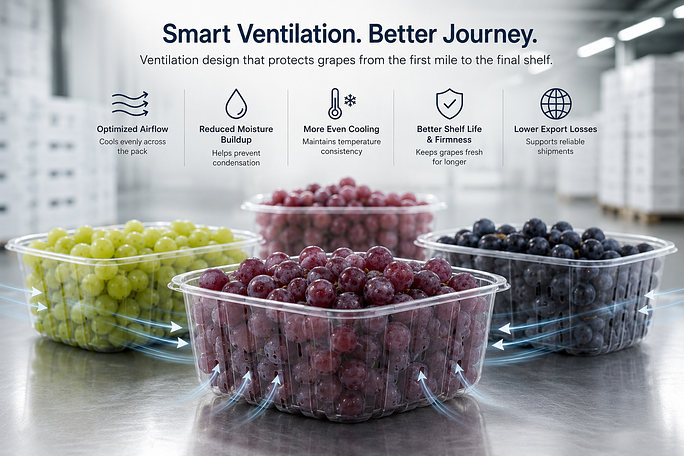
A grape shipment can leave the processing facility in excellent condition and still arrive with softened grapes, condensation, or reduced shelf life. Here is the thing: the temperature may have remained constant throughout the journey, yet the quality still changes during transit. In most cases, the shift happens slowly within the pack as cooling becomes uneven and moisture begins to build up across the shipment.
And this usually starts much earlier than exporters expect.
A grape punnet does more than hold fruit together. It affects how cooling air moves through the pack, how moisture escapes, and how consistently the grapes behave across the cold chain. When ventilation is not properly designed, the conditions inside the pack are harder to manage during storage and transit.
Why airflow matters in grape packaging
Even after harvest, grapes continue to release heat and moisture into the packaging. If that heat and moisture are not removed properly, condensation starts forming inside the punnet.
On the surface, airflow may seem like a small packaging detail. In grape exports, it usually becomes apparent only when quality starts to drop during transit.
Uneven cooling and trapped moisture are among the most common reasons product quality begins to decline during export handling. Even small temperature differences across cartons and pallets can lead to condensation, grape softening, and shorter shelf life by the time the shipment reaches the destination market.
A well-designed grape punnet allows cooling air to flow through the pack rather than simply circulating around it. That helps reduce trapped moisture, improve cooling consistency, slow condensation buildup, and maintain fruit firmness during transit.
In real export conditions, ventilation design becomes part of the protection of shelf life throughout the journey.
How poor ventilation increases export losses
Ventilation issues are not always obvious at the packing stage. The punnet may still look perfectly fine when the shipment leaves the facility. But once pallets move into cold storage or long-distance transit, airflow weaknesses become easier to notice.
If vents are too small, blocked during stacking, or inconsistent between packs, cooling air may bypass sections of the grape punnet completely. That creates uneven cooling and trapped moisture inside the pack.
And once moisture starts building up, the fruit’s condition begins to change quickly. Condensation forms more easily, grapes soften faster, and shelf life becomes less predictable.
At the export scale, even small airflow inconsistencies can become costly. Rejection risk increases, product value drops, and buyers receive less consistent fruit quality across shipments.
Why pallet-level airflow matters more than most exporters expect
A grape punnet does not move through the supply chain on its own. It moves as part of a stacked system. Once punnets are packed into cartons and pallets, airflow needs to move consistently across multiple packaging layers. If vent placement does not align properly across the load, cooling becomes uneven from one section of the pallet to another.
This is where packaging geometry starts making a real difference.
When airflow moves consistently across stacked punnets, pack temperatures stabilize more evenly, moisture accumulation reduces, and fruit quality remains more consistent across the shipment. And in fresh produce exports, even small differences in cooling performance can affect the final commercial outcome.
Why thermoforming consistency affects ventilation performance
A ventilation design only works properly when the packaging itself is manufactured consistently. In thermoformed packaging, even small variations in forming accuracy can slightly change vent shape, vent depth, or airflow pathways across production runs. These variations may seem minor individually, but across thousands of punnets moving through the cold chain together, they begin to affect airflow behavior within the system.
This becomes especially important in high-volume fresh produce packaging, where consistency directly affects how reliably the packaging performs during export handling.
AVI Global Plast manufactures thermoformed fresh produce packaging using food-contact-compliant rPET materials designed for consistency, traceability, and reliable forming behavior. Stable thermoforming helps maintain vent accuracy across production runs and supports more predictable airflow performance during export transit.
Why is condensation often a packaging airflow issue
Many grape quality issues are initially treated as refrigeration problems. But in practice, packaging airflow often plays a much more significant role than anticipated.
When airflow is restricted, moisture remains trapped inside the pack for longer. Cooling becomes uneven, condensation forms more easily, and product deterioration starts accelerating during transit.
Over time, this affects firmness, appearance, shelf-life stability, and overall export reliability. For exporters, these are not the sole packaging problems. They directly affect shipment consistency, buyer confidence, and product value at destination.
Why ventilation design is becoming more important in exports
Fresh produce supply chains are becoming more demanding. Shipments travel longer distances, pass through multiple handling stages, and spend more time in temperature-controlled environments.
As a result, packaging is no longer being judged only by how it looks on the shelf. Exporters are paying much closer attention to how it performs throughout the journey.
Ventilation design now influences cooling behavior, moisture control, pallet efficiency, shelf-life consistency, and export losses. That is why packaging decisions are increasingly moving toward airflow performance, forming consistency, and cold-chain reliability rather than focusing only on visual appeal.
FAQs
What does ventilation do in a grape punnet?
Ventilation helps cool air move through the pack, reducing trapped moisture and supporting more even temperature control during storage and export transit.
Ventilation helps cool air move through the pack, reducing trapped moisture and supporting more even temperature control during storage and export transit.
Why does condensation form inside grape packaging?
Condensation forms when the moisture released by the grapes cannot escape efficiently or when airflow inside the punnet becomes restricted.
Can poor vent placement affect grape shelf life?
Yes. Uneven airflow can create localized warm zones and moisture buildup, increasing spoilage risk and reducing shelf life.
Why is pallet airflow important in fresh produce exports?
Punnets move in stacked pallet systems. If airflow becomes inconsistent across the pallet, some sections cool differently from others, leading to uneven product quality across the shipment.
Why does thermoforming consistency matter in ventilated packaging?
Consistent thermoforming helps maintain accurate vent geometry across production runs, supporting more stable airflow and predictable packaging performance.
Why does ventilation design directly affect export performance
Ventilation design in a grape punnet directly affects how grapes cool, how moisture behaves inside the pack, and how consistently the product performs during export transit.
When airflow becomes uneven, condensation builds faster, shelf life becomes less stable, and export losses across the supply chain begin to increase.
But when vent placement, thermoforming consistency, and pallet airflow are engineered properly, packaging becomes part of the product protection itself rather than simply a container for the fruit.
At AVI Global Plast, ventilation performance is approached as part of a connected packaging system where material consistency, precision forming, and airflow design work together to support reliable cold-chain performance.
The result is straightforward. Packaging that supports shelf life, improves shipment consistency, and performs reliably across export conditions.