
Introduction: Why strawberry packaging fails in real supply chains
Strawberries do not fail in the field. They fail in transit.
A few hours of compression during transport, uneven pre-cooling, or moisture trapped inside the pack can accelerate softening and condensation. What begins as a minor handling issue quickly turns into visible quality loss by the time the fruit reaches retail. For exporters and retailers, this directly affects cost, inventory movement, and shelf presentation across fresh produce supply chains.
Packaging is expected to prevent these outcomes. It must protect the fruit, manage airflow, and maintain clarity, while meeting recycled content targets. This raises a practical question.
Can 100% rPET strawberry clamshell packaging perform consistently across global supply chains?
Why food-grade rPET is difficult to achieve
Recycled PET is not a uniform material.
Post-consumer PET carries residues from previous use, including organic traces, cleaning chemicals, and label adhesives. Even after washing, some contaminants remain embedded within the polymer matrix.
For food-contact applications, this creates a compliance barrier. Regulatory frameworks such as EFSA and FDA require validated decontamination processes before recycled PET can be used for direct food contact. Conventional washing removes surface impurities. It does not remove contaminants absorbed within the polymer structure.
This is why a large portion of recycled PET has historically been used in fibres or non-food applications. The limitation has not been recycling itself, but achieving consistent purity at scale for food-grade rPET packaging.
What is Starlinger deCON technology and how it works
Starlinger’s deCON technology addresses this limitation through a controlled thermal and vacuum-based decontamination process.
Recycled PET flakes are exposed to defined temperature, pressure, and residence time conditions inside reactors. Under these conditions, contaminants migrate from within the polymer matrix to the surface and are removed.
The process follows diffusion-based decontamination principles and is validated using surrogate contaminants under controlled testing conditions to demonstrate removal efficiency and ensure food-contact compliance.
In addition to decontamination, the process stabilises material properties such as intrinsic viscosity, which directly affects rPET thermoforming behaviour.
This makes the output suitable for food-contact applications and ready for conversion into packaging formats such as thermoformed strawberry clamshells.
Material purity alone, however, does not guarantee packaging performance.
From decontamination to performance: the process link
To enable reliable packaging, deCON technology ensures contaminant removal and input purity, sheet extrusion stabilises viscosity, moisture, and thickness, and thermoforming converts material consistency into functional packaging.
These stages are interdependent. When managed as a connected system, they create a direct pathway from recycled input to repeatable packaging performance.
Why material consistency becomes the real challenge
Once recycled PET enters production, variability becomes the main risk.
Differences in intrinsic viscosity, melt behaviour, or moisture levels affect how the material performs during sheet extrusion and thermoforming. In practice, this leads to uneven wall thickness, reduced clarity, or brittle forming. These outcomes affect stacking strength, hinge reliability, and the ability of the pack to withstand handling across the supply chain.
At higher recycled content levels, these risks increase unless process control improves proportionately.
The role of sheet extrusion in controlling rPET behaviour
Sheet extrusion determines whether material consistency is achieved.
In high-volume production, small deviations in viscosity or temperature translate into recurring forming defects. This makes extrusion control critical when working with high levels of recycled content.
At AVI Global Plast, this stage is managed within a fully integrated manufacturing system supported by a 300,000 sq. ft. production facility, an annual PET sheet capacity of 24,000 tonnes, and 8 high-speed thermoforming lines serving customers across 30+ countries and 6 continents.
Intrinsic viscosity is monitored inline and corrected in real time, while automatic thickness control systems maintain tight tolerances across production runs, typically within narrow micron-level ranges. Real-time process adjustments reduce batch-to-batch variation.
Because extrusion, tooling, and thermoforming are handled within the same system, variability between stages is reduced. This ensures predictable material behaviour before forming begins and avoids inconsistencies typically seen when these processes are separated across different suppliers.
Why thermoforming performance determines packaging reliability
Thermoforming converts sheet into functional packaging, and it is where variation becomes visible.
Any inconsistency in sheet quality translates directly into defects across batches, including uneven wall distribution, reduced clarity, or structural weakness. These defects repeat at scale and affect performance during stacking, transport, and handling.
When sheet quality is controlled, thermoforming delivers uniform wall distribution, consistent optical clarity, and reliable hinge and structural strength.
For strawberry clamshell packaging, this is critical. The pack must maintain structural strength under load while allowing airflow and preserving visibility.
Performance at this stage determines whether packaging performs across real logistics conditions.
Why the strawberry clamshell remains the dominant format
The continued use of strawberry clamshell packaging is driven by functional performance.
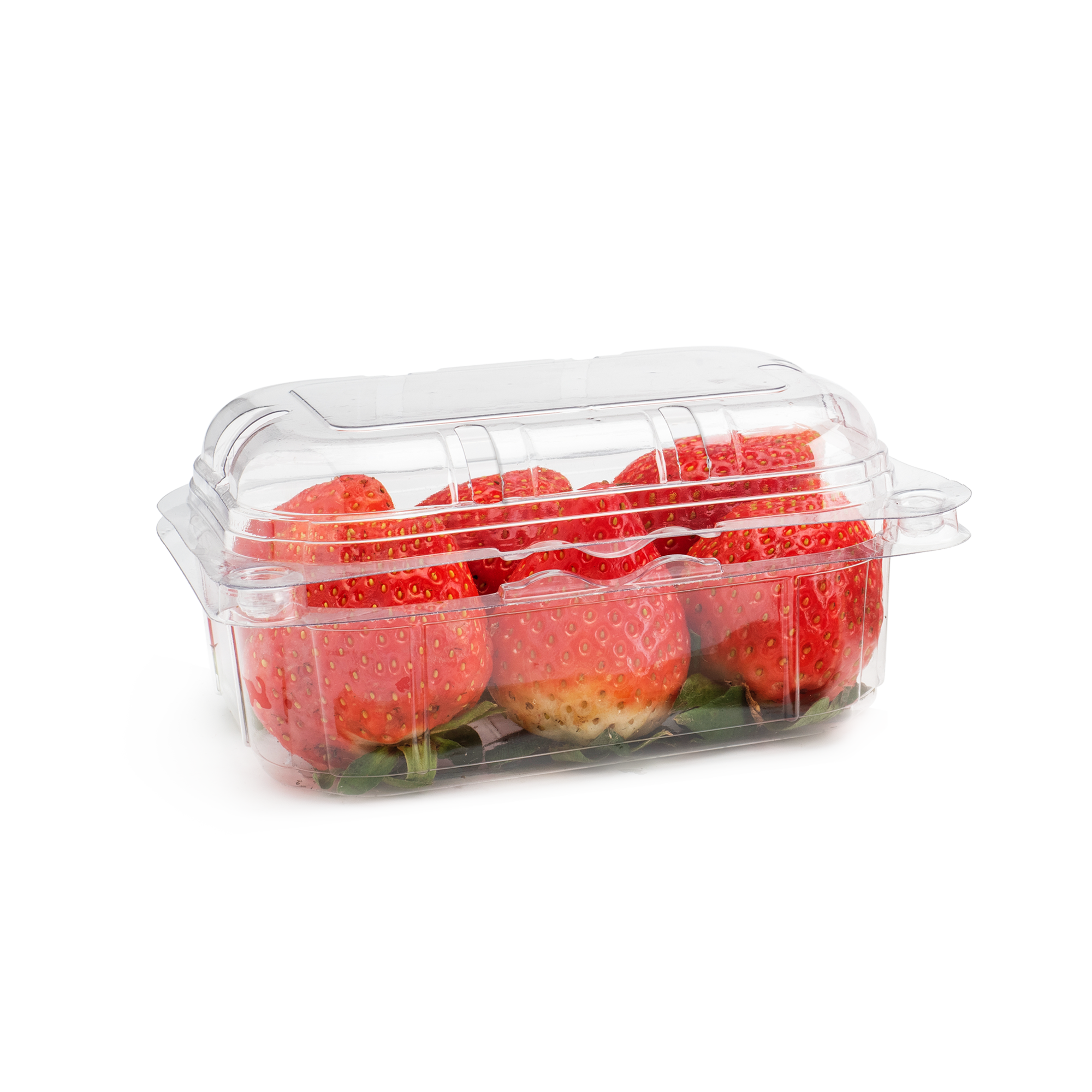
Rigid walls protect fruit during stacking. Ventilation openings support airflow during pre-cooling and cold-chain storage, helping manage condensation. Transparent surfaces allow product inspection without opening the pack.
These features operate together. Removing or weakening one affects overall performance.
Design improvements such as controlled ventilation geometry and downgauged structures allow material reduction without compromising strength.
This balance between protection, airflow, and efficiency explains why the format remains widely used across global fresh produce supply chains.
Can 100% rPET replace virgin PET in thermoforming
Concerns around 100% rPET are based on real production challenges.
Without controlled decontamination and processing, recycled material can lead to clarity loss, reduced stiffness, and inconsistent forming behaviour. These risks increase at higher recycled content levels.
When high-purity input from Starlinger deCON technology is combined with controlled extrusion and thermoforming, these limitations can be addressed.
Under these conditions, 100% rPET strawberry clamshell packaging can deliver structural integrity, optical clarity, and consistent thermoforming performance comparable to virgin PET.
The determining factor is not the material alone, but the system used to process it.
Packaging decisions are shifting from material to system
The transition to recycled packaging is no longer a material substitution exercise.
It is a system-level decision where decontamination, extrusion, forming, and design operate together.
For fresh produce packaging, this has direct commercial impact. Poor packaging performance increases spoilage and product loss, offsetting the benefit of recycled content. A controlled system allows both objectives to be achieved, reduced dependence on virgin plastic and consistent protection of perishable products.
Conclusion: from recycled content to repeatable performance
The feasibility of 100% rPET strawberry clamshell packaging is no longer in question. Technologies such as Starlinger deCON have addressed the barrier of food-grade compliance.
The focus has now shifted to consistency.
The challenge is not achieving performance once, but repeating it across batches, production lines, and supply chains.
At AVI Global Plast, this is enabled through scale, process control, and integration, combining food-grade rPET, precision extrusion, and high-speed thermoforming within a single manufacturing ecosystem.
The outcome is measurable. Consistent packaging performance, reduced spoilage risk, and reliable supply across global fresh produce supply chains.
Frequently Asked Questions (FAQs)
Is 100% rPET safe for food packaging?
Yes. When processed using validated decontamination technologies such as Starlinger deCON and produced under controlled conditions, rPET meets EFSA and FDA requirements for direct food-contact applications.
How does Starlinger deCON technology remove contaminants?
It uses a combination of heat, vacuum, and controlled residence time to enable diffusion-based removal of contaminants from within the PET polymer structure.
Can rPET match virgin PET in thermoforming?
Yes. When intrinsic viscosity, moisture levels, and extrusion conditions are tightly controlled, rPET can deliver comparable thermoforming performance to virgin PET.
What is intrinsic viscosity in PET and why does it matter?
Intrinsic viscosity reflects molecular weight and directly affects strength, clarity, and thermoforming behaviour. Stable intrinsic viscosity is required for consistent packaging performance.
Closing line