
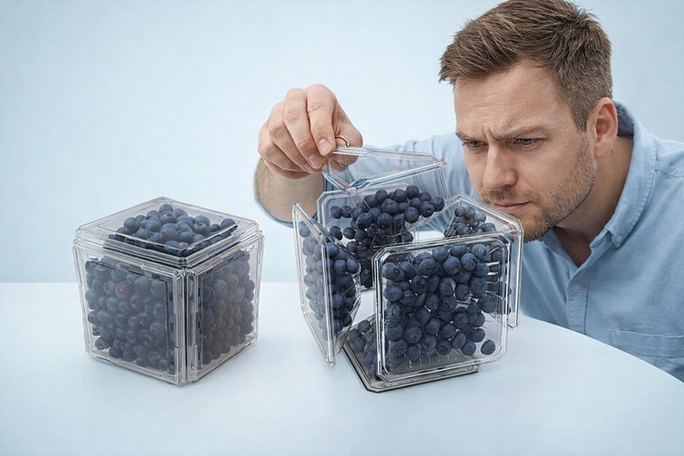
Blueberries move through one of the most space-sensitive supply chains in the fresh produce industry. Every shipment depends on how efficiently that space is used. Small inefficiencies at the packaging level often go unnoticed at origin but become apparent during transport, storage, and distribution. That is where packaging begins to influence cost.
For exporters, the challenge is not just protecting fruit. It is about moving more product within the same footprint while maintaining consistency across handling conditions. This is where pallet efficiency becomes a measurable advantage.
Why traditional punnet formats limit space utilization?
Most conventional punnets are designed to nest when empty. While this supports upstream logistics, the same tapered geometry creates gaps once the packs are filled. Across a pallet, these gaps translate into unused volume. Over multiple layers, the impact becomes significant. This directly affects export packing density and reduces the amount of product that can be shipped per load.
The outcome is straightforward. More shipments are required to move the same quantity of blueberries.
How geometry changes packing outcomes?
Packaging does not operate in isolation. The way individual units combine determines how efficiently space is used. This is where cubic design improves performance.
When filled punnets align into uniform shapes, they reduce the empty space between packs. This enables tighter carton configurations and more stable pallet structures. The benefit is not only higher packing density but also improved load consistency during transport.
From individual packs to system-level efficiency
In practice, packaging performance is evaluated at scale. When punnets are designed to align consistently, they distribute the load more evenly across the pallet. This reduces movement during transit and improves stacking reliability across different handling stages.
These improvements contribute directly to logistics cost reduction by optimizing transport volumes and reducing handling inefficiencies.
Why consistency matters more than design alone
Design improvements alone are not enough if production lacks control. Variations in thickness, rigidity, or forming accuracy affect how punnets behave when stacked. Inconsistent packs create uneven loads, increasing the risk of compression damage and pallet instability.
Consistency ensures that every unit performs as part of a larger system rather than as an isolated container.
The role of material and process control
Material behaviour defines how packaging performs under real conditions. Variations in intrinsic viscosity or moisture levels influence forming accuracy and structural strength. When extrusion and thermoforming are controlled within a single system, these variations can be minimized.
This allows packaging to maintain dimensional accuracy and predictable performance across production runs.
Why blueberry punnets remain central to export logistics
Blueberry shipments require packaging that balances protection, airflow, and space utilization.
Punnets must support stacking strength while maintaining ventilation and clarity. When these elements are aligned, packaging contributes not only to product protection but also to operational efficiency.
The focus shifts from simply holding the fruit to enabling better movement across the supply chain.
Conclusion: from packaging format to logistics performance
Packaging decisions increasingly influence logistics outcomes. When punnets are engineered for alignment and consistency, they improve pallet efficiency without compromising product protection. Over time, this creates measurable improvements in supply chain performance.
At AVI Global Plast, this is achieved through integrated manufacturing, where material control, extrusion, and thermoforming operate as a connected system. The result is packaging that performs consistently across real supply chain conditions, supporting both efficiency and reliability at scale.
FAQs
How do blueberry punnets improve pallet efficiency?
They align more uniformly during stacking, reducing unused space and allowing better utilization of pallet volume.
They align more uniformly during stacking, reducing unused space and allowing better utilization of pallet volume.
What is export packing density in fresh produce logistics?
It refers to the amount of product that can be packed within a fixed shipping space while maintaining stability and protection.
It refers to the amount of product that can be packed within a fixed shipping space while maintaining stability and protection.
Why does packaging design affect logistics costs?
Inefficient designs create unused space, increasing the number of shipments required and raising transport and storage costs.
Inefficient designs create unused space, increasing the number of shipments required and raising transport and storage costs.
What role does material consistency play in packaging performance?
Consistent material behaviour ensures uniform forming, which supports stable stacking and predictable handling across supply chains.
Consistent material behaviour ensures uniform forming, which supports stable stacking and predictable handling across supply chains.
Can packaging design reduce shipping costs without affecting product safety?
Yes. When geometry and process are optimized together, packaging can improve space utilization while maintaining protection.
Yes. When geometry and process are optimized together, packaging can improve space utilization while maintaining protection.
Closing line