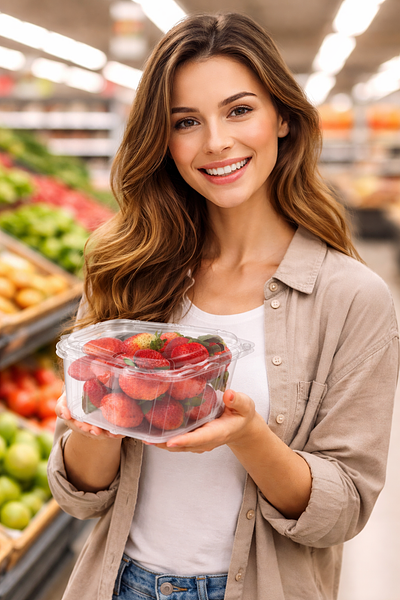
Strawberries move through one of the most condition-sensitive supply chains in fresh produce. Their quality depends not only on how they are handled, but on how consistently their environment is managed across stages. Small changes inside the pack often go unnoticed at the origin. But over time, they begin to influence product quality across storage, transport, and retail.
That is where packaging begins to shape outcomes.
For exporters, the challenge is not only protecting fruit. It is about maintaining stability within the pack as conditions change. This is where ventilation design becomes a critical factor.
Why airflow controls product behavior
Fresh strawberries continue to respire after harvest. They release heat and moisture, especially during early cooling and storage stages.
When airflow is restricted, this heat remains trapped within the pack. Over time, localized temperature variation begins to develop, affecting consistency across the load. The result is uneven product condition.
How moisture builds inside the pack
Moisture does not form instantly. It accumulates gradually when airflow is limited or inconsistent. In closed or poorly ventilated packs, water vapor released from the fruit remains trapped within the container. This creates localized humidity zones that affect surface condition and visual quality.
This directly relates to moisture control within the packaging system. Managing this balance is essential. Too much retention leads to condensation. Too much exposure leads to dehydration.
Why does cooling performance depend on airflow
Cooling is a time-sensitive stage in the supply chain. If airflow through the packaging is restricted, temperature reduction becomes uneven across stacked layers. Some areas cool efficiently, while others retain heat.
This inconsistency affects overall product stability. Packaging that supports cooling efficiency allows air to move uniformly across packs, improving temperature consistency from packhouse to distribution.
From internal conditions to shelf outcomes
The condition of strawberries at retail is shaped by how they behave inside the pack during earlier stages. When airflow is controlled, fruit maintains firmness, color, and surface quality. When it is not, early-stage variability becomes visible at the shelf. This is where packaging influences shelf life.
The objective is not only to extend duration, but to maintain consistency across different storage and display environments.
Why structure and airflow must work together
Ventilation alone does not determine performance. It must function within a structurally stable pack. During stacking and transport, containers are exposed to load and movement. Poorly designed airflow openings can weaken the structure or cause uneven pressure distribution.
This creates trade-offs between protection and airflow.
A well-designed punnet integrates both without compromising either.
Preventing damage across handling stages
Strawberries pass through multiple handling points before reaching the consumer. If airflow is uneven, moisture accumulation softens the fruit surface, making it more susceptible to compression and abrasion during transport.
This is where damage prevention becomes linked to internal pack conditions.
Stable airflow helps maintain firmness, reducing the impact of external handling stress.
Why strawberry punnets remain essential in supply chains
Strawberry punnets are designed to manage airflow, protection, and visibility simultaneously.
Ventilation supports internal conditions. Structural features support stacking. Transparency allows inspection without handling.
These elements function together as part of a system. The focus is not only on containing the fruit, but on maintaining controlled conditions across the supply chain.
In essence: from airflow to consistent performance
Packaging decisions influence how fruit behaves beyond the pack. When ventilation is engineered correctly, it supports temperature stability, manages moisture behavior, and improves consistency across handling stages. Over time, this leads to better product outcomes and reduced variability.
At
AVI Global Plast, this is achieved through integrated manufacturing, where material behaviour, forming precision, and airflow design operate as a connected system. The result is packaging that performs consistently across real supply chain conditions.
FAQs
Why is ventilation important in strawberry punnet packaging?
It allows controlled airflow around the fruit, helping maintain stable temperature and internal conditions during storage and transport.
How does moisture affect strawberry quality?
Excess moisture leads to condensation, which softens the fruit surface and affects visual and structural quality.
What role does cooling play in strawberry packaging?
Cooling stabilizes the fruit after harvest, but it depends on airflow through the packaging for uniform performance.
Can packaging design improve the shelf life of strawberries?
Yes. When airflow and structure are balanced, packaging helps maintain consistent product quality over time.
How does airflow help reduce damage during transport?
By maintaining stable internal conditions, airflow reduces softening and makes fruit less vulnerable to handling stress.
Closing line
Explore how AVI Global Plast designs strawberry punnets with optimized
ventilation design to support consistent performance across global fresh produce supply chains.