
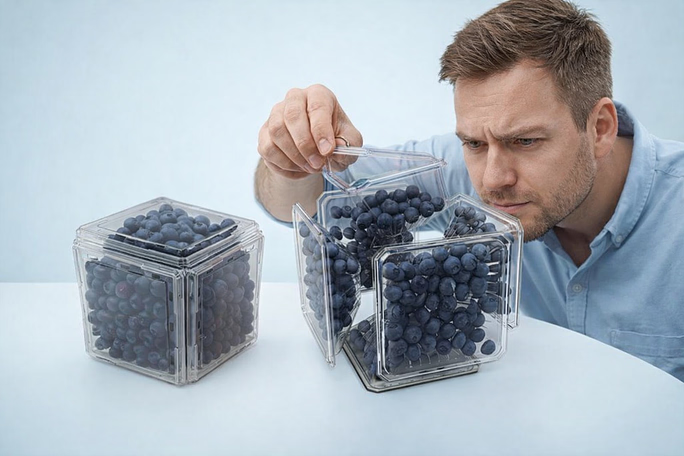
Most conventional punnets are designed to nest when empty. While this supports upstream logistics, the same tapered geometry creates gaps once the packs are filled. Across a pallet, these gaps translate into unused volume. In many palletized shipments, up to 50% of the available space can effectively be empty air rather than product.
How does geometry change packing outcomes?
Packaging does not operate in isolation. The way individual units combine determines how efficiently space is used. This is where Q-Bic design changes outcomes. Instead of functioning as individual tapered packs, Q-Bic formats allow filled punnets to align into uniform, space-efficient structures. When combined inside cartons, these packs reduce the voids typically seen between conventional formats.
From individual packs to system-level efficiency
In practice, packaging performance is evaluated across full pallet loads rather than individual units. When punnets are designed to align consistently, they distribute load more evenly and reduce movement during transit. This has a measurable effect. Trials in commercial blueberry programs indicate that optimized packing formats can nearly double pallet efficiency compared to traditional clamshell configurations.
Before vs after: the shift in packing performance
The difference between traditional and Q-Bic formats becomes clearer when compared directly.
- Tapered structure creates gaps between packs.
- Lower pallet fill rates
- Higher number of shipments required
Q-Bic-aligned punnets:
- Uniform geometry reduces empty space.
- Improved carton fit and pallet stability
- Up to 50% reduction in transport volume in large-scale programs
Why consistency matters more than design alone
Design improvements alone are not enough if production lacks control. Variations in thickness, rigidity, or forming accuracy affect how punnets behave when stacked. Inconsistent packs create uneven loads, increasing the risk of compression damage and pallet instability. Even small deviations can disrupt alignment, reducing the benefits of improved geometry.
The role of material and process control
Material behaviour defines how packaging performs under real conditions. Variations in intrinsic viscosity or moisture levels influence forming accuracy and structural strength.
Beyond space: impact on materials and operations
Improved geometry does more than increase packing density. It also affects secondary packaging and operational flow.
- fewer pallet movements
- fewer loading and unloading cycles
- lower cold storage volume requirements
Why blueberry punnets remain central to export logistics
Blueberry shipments require packaging that balances protection, airflow, and space utilization. Punnets must support stacking strength while maintaining ventilation and clarity.
Conclusion: from packaging format to logistics performance
Packaging decisions increasingly influence logistics outcomes. When punnets are engineered for alignment and consistency, they improve pallet efficiency without compromising product protection.
FAQs
They align more uniformly during stacking, reducing unused space and enabling better pallet utilization.
It refers to how much product can be packed within a fixed shipping volume while maintaining stability and protection.
Inefficient designs create unused space, increasing the number of shipments and raising transport and storage costs.
It allows punnets to combine into space-efficient structures, reducing gaps and improving overall load stability.
Yes. When geometry and process control are optimized together, packaging can improve space utilization while maintaining protection.Explore how AVI Global Plast designs blueberry punnets that improve pallet efficiency and support consistent performance across global supply chains.