
Why Traceability Defines the Credibility of rPET Packaging?
Traceability in recycled plastics has shifted from a supportive practice to a structural requirement—especially where packaging intersects with food safety, regulation and public trust. As brands increase their use of rPET across high-visibility categories, they now expect more than broad sustainability promises. They want evidence: where the material originated, how it was processed and whether it meets safety thresholds that regulators, auditors and consumers can rely on. Regulatory frameworks are reinforcing this direction by linking market access not to declarations, but to demonstrable control over recycled inputs.
In rigid rPET thermoforming, this expectation becomes even sharper. rPET travels through a long and variable chain—collection, sorting, washing, flaking, decontamination, sheet extrusion and thermoforming—before it becomes packaging for fresh produce, snacking, bakery and chilled foods. Each stage introduces potential shifts in colour, intrinsic viscosity, contamination levels and mechanical behaviour, making one truth unavoidable: recycled plastics cannot be treated as a uniform commodity.
Within this environment, EN 15343 has become a key reference point. Unlike traditional material standards, EN 15343 treats recycling as a documented, auditable system—defining how traceability is established, how recycled content is calculated and how every step in the recycling chain is recorded in a way that independent auditors can verify. As brand expectations, compliance systems and manufacturing realities converge, the central question is no longer whether rPET can be used, but whether its journey from waste to packaging can be explained with clarity, consistency and technical depth.
How EN 15343 Strengthens Identity Preservation in Recycled Plastics?

Meeting Food-Grade Requirements with rPET: Balancing Safety and Recycled Content
This shift means that traceability begins long before rPET flakes enter the extruder. Packaging manufacturers now qualify post-consumer and post-industrial inputs using disciplines once reserved only for virgin resin. Measurements such as IV stability, thermal behaviour, filtration performance, colour tonality, contamination probability and NIAS risk assessments have become routine—increasingly essential as food-contact packaging demands both safety and transparency.
In India, FSSAI’s approval of rPET for food-contact applications has raised expectations for controlled input streams, validated decontamination technologies and accredited testing. Thermoforming converters are also referencing advanced European frameworks—including EU 10/2011 and EU 2022/1616—to guide migration testing, process validation and hygiene documentation, even when such rigour exceeds local requirements.
Meanwhile, Extended Producer Responsibility (EPR) has shifted focus from end-of-life outcomes to upstream design decisions. Brands now consider recyclability, recycled-content targets and recovery pathways before a single sheet is extruded, creating a more integrated supply chain where recyclers, packaging manufacturers and PROs operate with shared accountability.
Upstream variability remains a major challenge. India’s rPET ecosystem functions as a dual structure: highly capable formal recyclers work alongside vast informal networks, leading to fluctuations in bale quality, colour mix, contamination and material stability. To stabilise inputs, manufacturers are relying on long-term partnerships, plant audits, shared specifications and real-time data exchange—strengthening the foundation needed to scale rPET safely and consistently.
Technologies Enabling Higher rPET Content & Lower Environmental Impact
 EPR Frameworks and India’s Recycling Ecosystem: What Manufacturers Must Solve Next
 EPR Frameworks and India’s Recycling Ecosystem: What Manufacturers Must Solve Next
In this evolving landscape, structured yet flexible traceability models are gaining relevance. They enable brands to adopt recycled content confidently while protecting sensitive operational data. AVI Global Plast— one of India’s leading exporters of thermoformed rPET trays and food-grade rPET packaging — demonstrates how this balance of traceability, compliance, and commercial practicality can be engineered into everyday manufacturing.
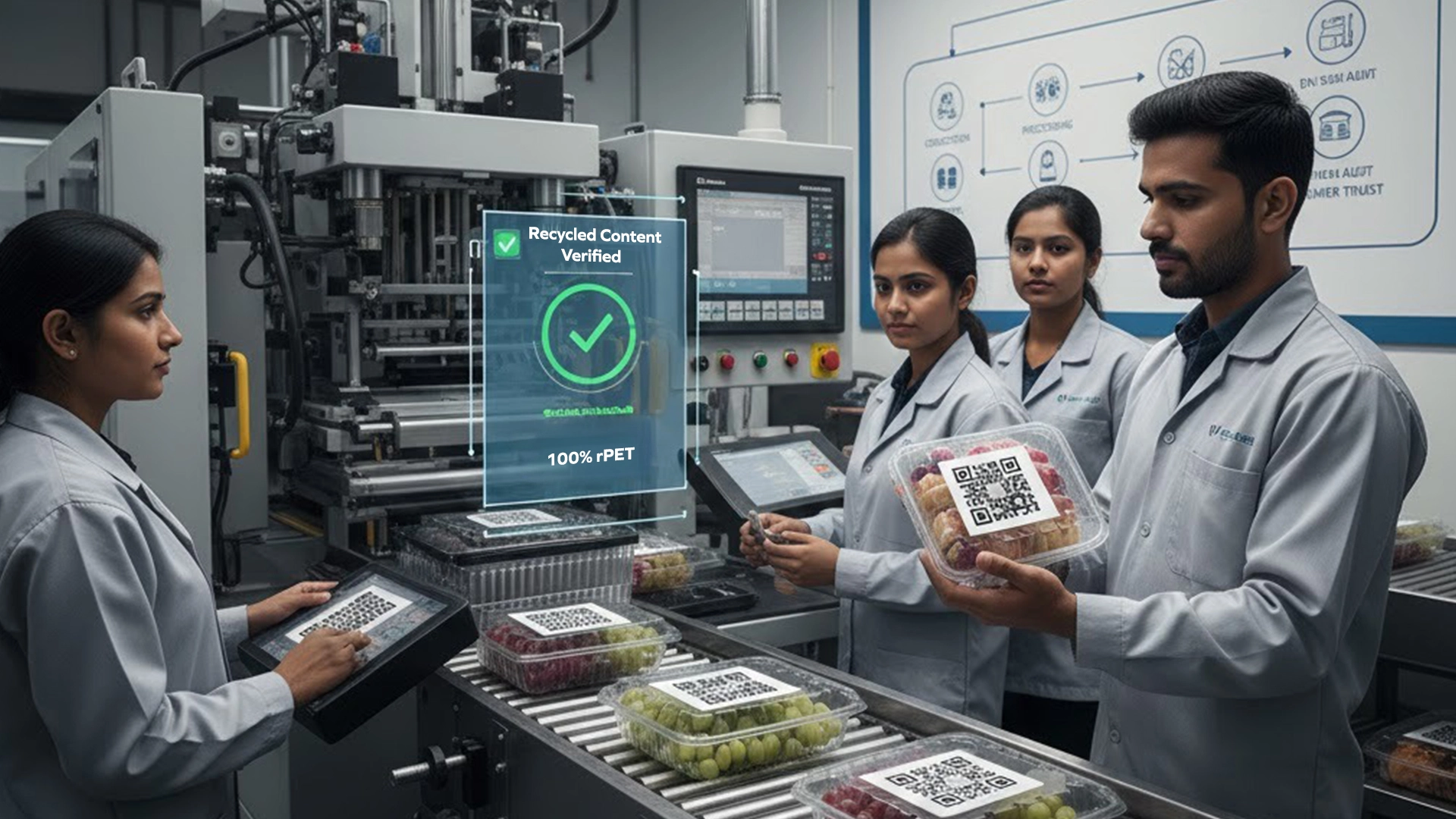
AVI aligns its recycled-content documentation with EN 15343 and undergoes independent verification through SGS audits, establishing a validated pathway that confirms recycled-content claims without exposing batch-level or plant-specific information. This verification framework is strengthened by disciplined material qualification, controlled sheet formulations, hygiene-linked processing and thermoforming that ensures clarity, impact strength and functional stability—even at higher recycled-content ranges.
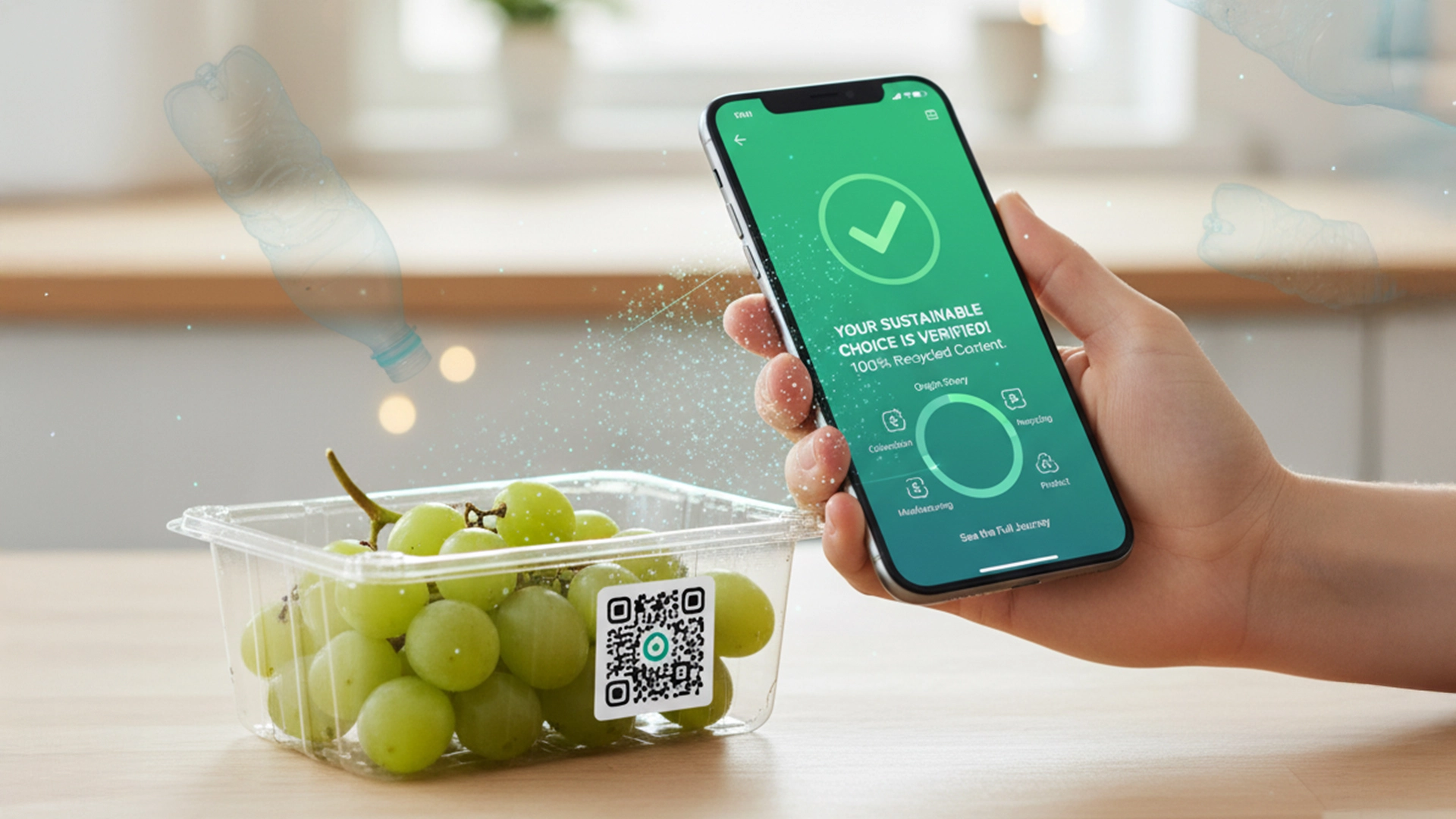
Building on this shift, AVI integrates QR-enabled communication on select rPET trays and containers through AVI Trace, its proprietary digital traceability platform. This allows brands to deliver concise, consumer-friendly information—such as recycled-content ranges verified under EN 15343-aligned systems—directly at the point of use. Across segments like grapes, berries, fresh snacking, bakery, chilled foods and ready-to-eat formats, the result is packaging that pairs high performance with high transparency, without adding any reporting load on brand teams.
As AVI’s Managing Director Akhilesh Bhargava explains: “Trust isn’t built at the end of the line — it’s engineered into the material from the moment it enters the system.”
Engineering recycled plastics for transparency is therefore not just an operational choice—it is the foundation for long-term circularity. It enables the packaging ecosystem to grow on systems that are reliable, auditable and built for the future.
FAQs
 FAQs
FAQs1. What is EN 15343 and why is it important for rPET packaging?
EN 15343 defines how to document the recycling chain, calculate recycled content and verify traceability. It ensures rPET used in food and fresh-produce packaging has proven origins and auditable processing records.
2. Why is traceability essential in rPET food packaging?
Traceability confirms where recycled material came from, how it was processed and whether it meets safety standards—helping brands avoid contamination risks and meet compliance requirements.
3. How does rPET qualify as food-grade material?
Through validated decontamination, strict input controls, migration testing and compliance with standards such as EN 15343, EU 10/2011, EU 2022/1616 and FSSAI guidelines.
4. What is AVI Trace?
AVI Trace is AVI Global Plast’s structured traceability platform designed around EN 15343 requirements, strengthened with SGS-verified audits and internal QC protocols, ensuring that all recycled-content claims on rPET packaging are accurate, transparent, and fully compliant.
5. How does SGS verification support recycled-content credibility?
SGS performs independent audits that verify recycled-content levels and traceability, strengthening the credibility of sustainability claims.
6. What technologies ensure safe and consistent rPET packaging?
High-vacuum decontamination reactors, advanced washing lines, IV stabilisation, controlled extrusion and precision thermoforming maintain clarity, strength and safety at high rPET percentages.
7. Why is PCR material quality inconsistent in India?
India’s PET ecosystem includes both formal recyclers and informal networks, creating variability in bale quality, colour, contamination and IV stability.
8. How are manufacturers improving PCR quality?
Through long-term recycler partnerships, plant audits, shared specifications, real-time data and material qualification aligned with EN 15343.
9. How does EPR influence rPET adoption?
EPR encourages brands to design recyclable packaging, set recycled-content targets and integrate recovery pathways from the earliest design stages.
10. Why does traceability increase consumer and brand trust?
Because traceability verifies recycled content, safety and compliance, enabling transparent communication and strengthening credibility across supply chains.